
GeoMarine Biotechnologies (P) Ltd
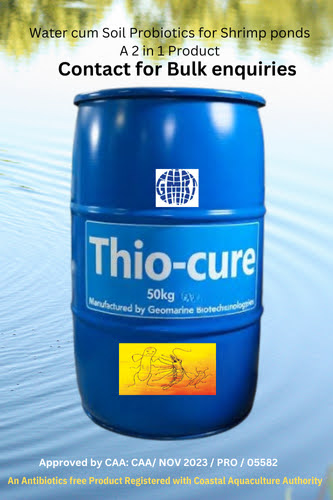
Thio-Cure
Why Soil Health Matters
Soil is like the umbilical cord for shrimp pond culture. The health of the pond soil is often compromised by excess feed residues, crashed algae, fecal matter, and the harmful bacteria that proliferate as a result.
This is precisely where Thio-Cure steps in — a specially and scientifically formulated microbial consortium that eliminates hydrogen sulphide, removes ammonia, and breaks down waste using a powerful blend of super-enzyme-producing microbes.
The microbial consortium at the heart of Thio-Cure is called Supremicos™ — a proprietary blend developed by GeoMarine Biotechnologies through years of research and field testing.
Unlike some commercial products that use bacteria working only in the presence of light, or only in anaerobic conditions, Thio-Cure contains a consortium of bacteria that work through different mechanisms — without needing light — and thrive under both aerated and anoxic conditions.
🔬 The Science Behind Thio-Cure
Two major toxic gases devastate shrimp ponds: hydrogen sulphide (H₂S) and ammonia (NH₃).
Understanding the nitrogen and sulphur cycles in pond ecosystems is the key to solving these problems. Nitrogen from amino acids, proteins, nucleic acids and mineral feed supplements accumulates as organic matter and is converted to ammonia by nitrogen-reducing bacteria.
Similarly, sulphur-containing amino acids, proteins, and minerals are converted to hydrogen sulphide by sulphur-reducing bacteria. In nature these processes are in harmony — but in a man-made pond ecosystem, one overtakes the other. This is where a soil probiotic like Thio-Cure restores balance.
Supremicos™ — The Proprietary Microbial Consortium
Each microorganism in the Supremicos™ consortium produces a battery of enzymes that complement the others — achieving maximum detritus removal, which in itself reduces toxic gas release, while simultaneously addressing ammonia and hydrogen sulphide. The result: a healthier pond, happier shrimps, and better yields.
Key Benefits
Clears Bottom Detritus
Breaks down accumulated organic matter at the pond bottom, facilitating better dissolved oxygen (DO) levels throughout the water column.
Reduces Toxic Gases
Actively reduces ammonia and hydrogen sulphide concentrations — the two gases most harmful to shrimp health and survival.
Improves Shrimp Health & Yield
Healthier pond conditions lead directly to better shrimp health, improved growth rates, and higher final yields at harvest.
Stabilises Algal Bloom
Helps maintain a stable and productive algal bloom in the pond — a vital component of a healthy aquaculture ecosystem.
Non-Pathogenic & Safe
Completely non-pathogenic to shrimps and pond handlers. Contains no antibiotics, hormones, or pathogens.
Works in All Conditions
Uniquely effective under both aerated and anoxic conditions — no dependence on light. Works 24/7 in your pond.
Microbial Composition
Each batch of Thio-Cure contains a precisely formulated consortium of 10 beneficial microorganisms in an inert filler (q.s.):
| # | Microorganism | CFU Count | Primary Role |
|---|---|---|---|
| 1 | Paracoccus pantotrophus | 1 × 10⁹ | Sulphur oxidation, denitrification |
| 2 | Thiobacillus denitrificans | 1 × 10⁹ | Hydrogen sulphide removal |
| 3 | Bacillus pumilis | 2 × 10⁹ | Enzyme production, detritus breakdown |
| 4 | Bacillus subtilis | 2 × 10⁹ | Broad spectrum enzyme production |
| 5 | Bacillus licheniformis | 2 × 10⁹ | Protease & amylase production |
| 6 | Bacillus megaterium | 1 × 10⁹ | Organic matter decomposition |
| 7 | Bacillus amyloliquefaciens | 1 × 10⁹ | Amylase & protease, disease suppression |
| 8 | Nitrosomonas eutropha | 1 × 10⁹ | Ammonia oxidation (nitrification) |
| 9 | Nitrobacter sp. | 1 × 10⁹ | Nitrite oxidation (nitrification) |
| 10 | Saccharomyces sp. | 2 × 10⁸ | Organic breakdown, growth promotion |
Dosage & Presentation
📏 Recommended Dosage
- Pond preparation: 5 kg per hectare
- During culture: 2 kg per hectare
- To be propagated by mixing with 5 volumes of soil
- Or as advised by your Aquaculture consultant
📦 Available Pack Sizes
- 1 kg container
- 5 kg container
- 50 kg drum (bulk)
Contact us for bulk pricing and dealer enquiries.
⚠️ Important Notes
- For aquaculture use only
- Not for human use
- Contains no antibiotics, hormones, or pathogens
- Approved by Coastal Aquaculture Authority
- GST No: 33ADNPC4543L1ZI
Proof of the Pudding
Lab Results & Field Trial Data — Coming Soon
We are compiling laboratory efficacy data and pond trial results from field applications of Thio-Cure. This section will be updated shortly with photographic and analytical evidence of Thio-Cure's performance.
For references and technical data, please contact us directly.
Request Technical DataBulk Enquiries & Orders — Thio-Cure
Available across India. WhatsApp for fastest response.